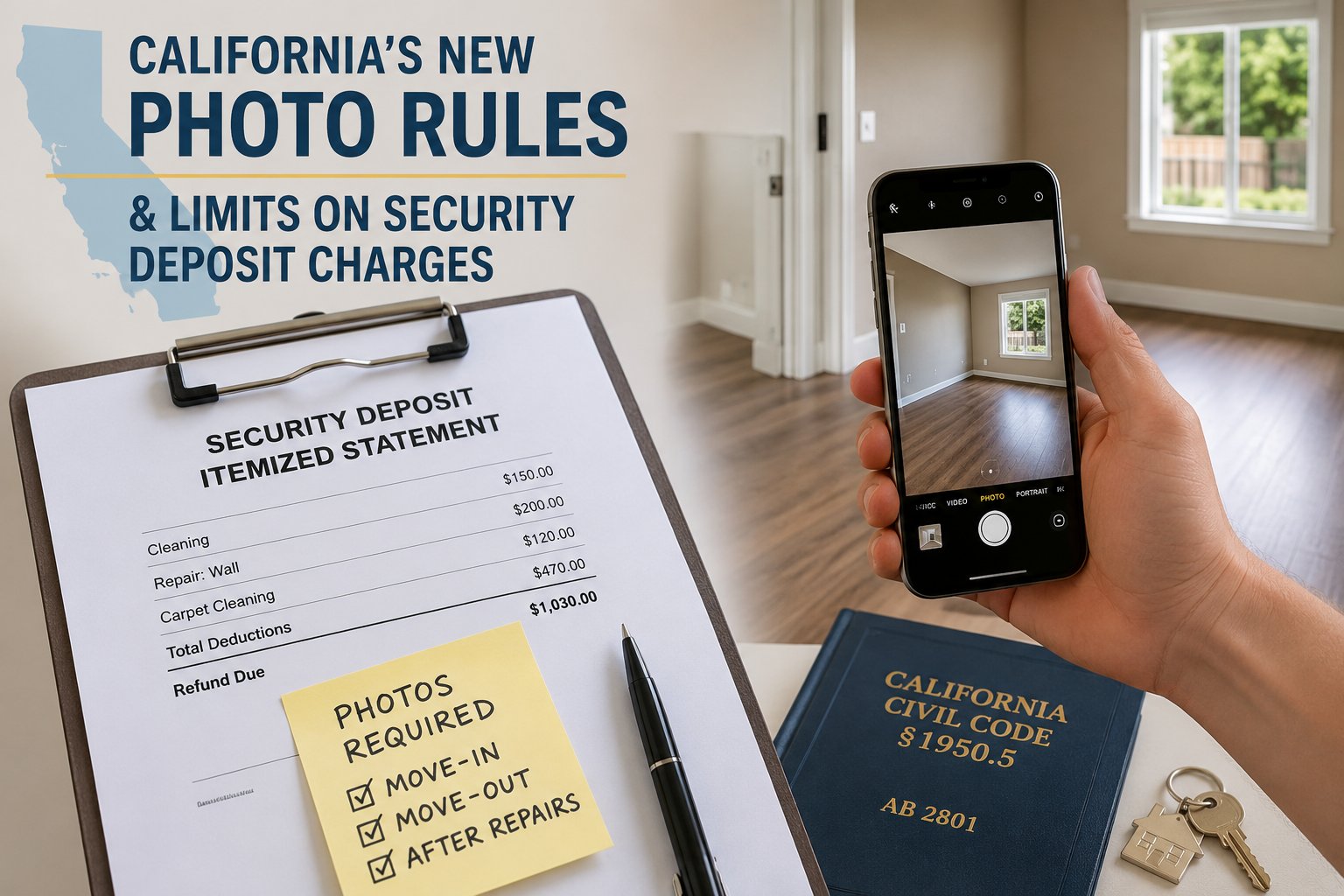
California's New Photo Rules and Limits on Security Deposit Charges.
Regarding the “new photo rules,” California already required landlords to provide an itemized statement and receipts for deductions from security deposits. Since AB 2801, landlords must also provide photographic documentation supporting deductions for repairs or cleaning. Those photo documentation requirements are being phased in:
- For tenancies beginning on or after July 1, 2025, landlords must provide photos taken:
- immediately before move-in,
- after move-out, before repairs/cleaning,
- after repairs/cleaning are completed.
Assembly Bill 2801—now part of Civil Code §1950.5—rolls out a new era of “pics or it didn’t happen” for residential rentals. Beginning in 2025, security deposit deductions must be backed by photos taken at move-in, move-out, and after repairs or cleaning. The goal: transparency, fairness, and fewer arguments about whether that stain was “already there.” In addition to the new photo requirements, the bill also reinforces limits on repair and cleaning charges that may be deducted from the security deposit. C.A.R. has created new forms—and updated existing ones—to assist real property owners or their authorized agents (“housing providers”) in complying with these changes. Below is a clear breakdown of what’s changing and how to stay compliant.
Why This Law Exists?
The law reinforces a long‑standing rule: deductions from a security deposit must be reasonably necessary to restore the property to its original condition, excluding ordinary wear and tear.
What’s new is the level of documentation required - photos at every key stage—to ensure transparency and fairness for both housing providers and tenants.
1. Move‑In Photos (Effective as of July 1, 2025)
Housing providers must take photos of the unit immediately before or at the start of the tenancy. A convenient time to take these photos is during the move-in inspection. These photos establish the baseline condition of the property—your “before” set.
- During the move‑in inspection, housing providers may use the Move-In Inspection form (“C.A.R. Form MII”) to document the unit’s condition while simultaneously capturing the required photos.
- If the summary box on the first page of Form MII is checked, the Move-In Inspection Summary (C.A.R. Form MII-SUM) is generated, providing a concise list of only the items that need attention. This documentation helps identify any repairs needed and benefits both the housing provider and tenant when evaluating the unit’s condition at the end of the tenancy.
2. Pre–Move Out Inspection – No Photos Required
Housing providers must still offer tenants a pre–move–out inspection within a reasonable time after either the housing provider or the tenant has indicated their intent to terminate the tenancy. This inspection is done to provide the tenant with the opportunity to remedy deficiencies and avoid certain deductions from the security deposit.
The inspection may not be scheduled earlier than two weeks before the end of the tenancy. Housing providers can use the Notice of Right to Inspection (C.A.R. Form NRI) to provide notice to the tenant of their right to the pre-move-out inspection and the opportunity to request it.
- No photos are required at this stage.
- If the tenant requests the inspection, the Pre-Move Out Inspection form (C.A.R. Form PMOI) can be used to document any issues identified during the walkthrough. Checking the summary box on C.A.R. Form PMOI generates the Pre-Move Out Inspection Summary Statement (C.A.R. Form PMOI-SUM), which lists only the items requiring attention. This step gives tenants a chance to fix issues before the final inspection to avoid certain deductions from the security deposit.
3. Move‑Out Photos (Effective as of April 1, 2025)
After the tenant returns possession—but before any repairs or cleaning—housing providers must take photos documenting the unit’s condition.
- During the move‑out inspection, housing providers can use the Move-Out Inspection form (C.A.R. Form MOI) to document the property's condition. The Move-out photos can be taken during the inspection. Checking the summary box on the first page generates the Move‑Out Inspection Summary (C.A.R. Form MOI‑SUM), which provides a simplified list of items needing attention.
These photos serve as the “after” counterpart to the move‑in set and to any issues identified during the pre–move‑out inspection.
4. Post‑Repair and Post‑Cleaning Photos (Effective as of April 1, 2025)
Once repairs or cleaning are completed, housing providers must take another set of photos showing the final condition of the unit. This closes the documentation loop and supports any deductions made.
What Must be Provided to Tenants
When returning the itemized statement of deductions, housing providers must include:
- Move‑in photos
- Move‑out photos
- Post‑repair and post‑cleaning photos
- Copies of documents (i.e., invoices, receipts, etc.) showing allowable charges incurred and deducted for repair or cleaning,
Photos may be delivered by mail, email, flash drive, or by providing a link where the tenant may view the photographs online.
Critical: If a housing provider, in bad faith, fails to provide the required photos, they lose the right to claim any portion of the security deposit.
Limits on Repair and Cleaning Charges
The law clarifies and reinforces long‑standing rules:
- Housing providers cannot charge for pre-existing damage or ordinary wear and tear.
- Charges for materials, contractor work, or the housing provider’s own labor must be reasonable and tied to restoring the unit to its original condition.
- Professional carpet cleaning or other professional cleaning services may only be charged if reasonably necessary to return the unit to its initial state.
In other words, charges like professional cleaning are not automatically deductible just because it’s the end of the lease — they must be justified.
Exception
If the total deductions for both repairs and cleaning do not exceed $125.00, then the provisions regarding photos and receipts are not required.
Updated C.A.R. Forms
The December 2025 versions of C.A.R. Forms MII, MOI, MII-SUM and MOI-SUM now include reminders about the new photograph obligations, helping REALTORS® and their clients stay compliant.
Final Thoughts
AB 2801 doesn’t reinvent the security‑deposit wheel—it just adds a camera to it. The law aims to reduce disputes by making documentation mandatory and standardized.
For tenants, it means transparency and fewer surprises.
For housing providers, it means proof of defects, issues, repairs, and cleaning, plus the added benefit of fewer disputes regarding the condition of the property and security deposit returns.
California’s new limits on residential security deposits under AB 12 became effective on July 1, 2024.
The law generally limits security deposits to one month’s rent for most residential rentals, whether furnished or unfurnished.
Key points:
- Prior law allowed up to:
- 2 months’ rent for unfurnished units
- 3 months’ rent for furnished units
- AB 12 changed this to:
- 1 month’s rent maximum for most landlords
- Limited exceptions apply to certain small landlords owning no more than 2 properties with up to 4 total units.
Have a fantastic day!
Best Regards,
Alena Lehrer
Luxury Real Estate Specialist
Compass, Beverly Hills
DRE 02120134
310.437.3700
[email protected]
www.AlenaLehrer.com